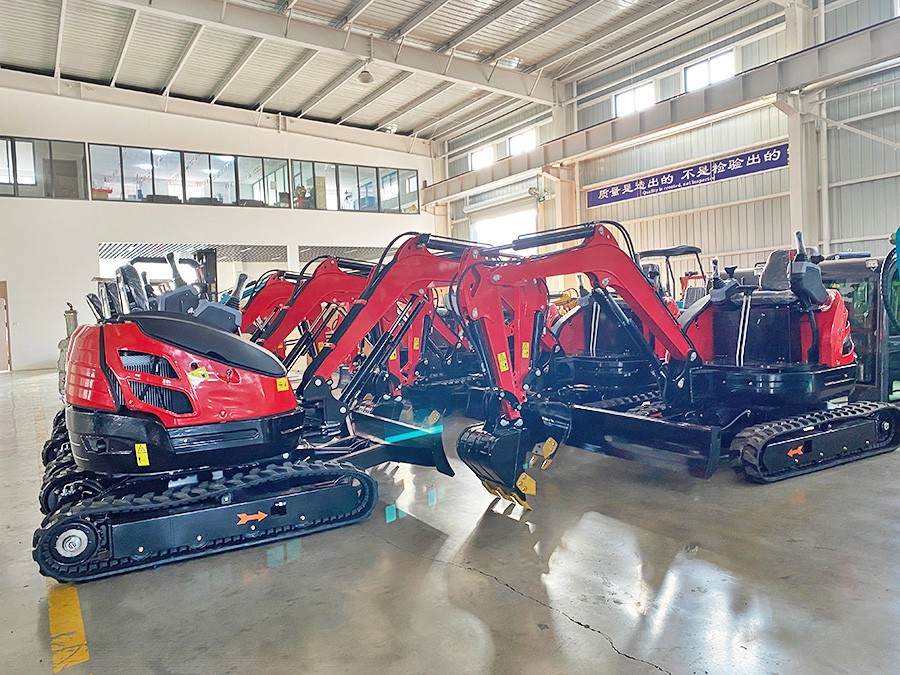
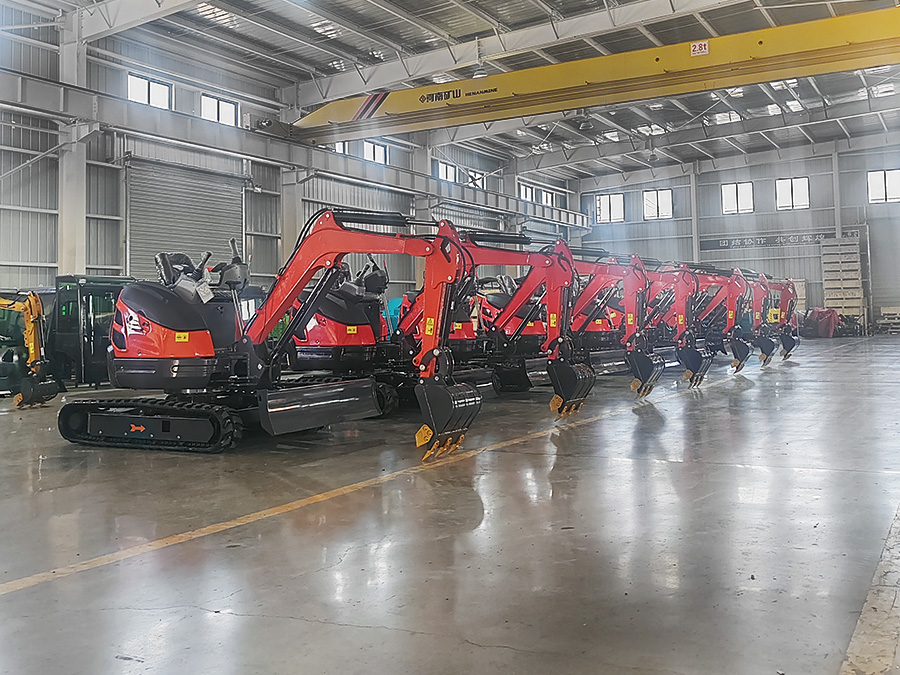
The efficient operation of a mini excavator relies on the coordinated operation of four core systems, and its technical principles revolve around "power transmission - precise control - flexible movement":
Powertrain: Mainstream models use diesel engines that meet China IV emission standards, with a power range of 20-55 kW. They are equipped with turbocharging technology, balancing power output and fuel economy (some high-end models have fuel consumption 15% lower than the industry average). The engine, as the "heart," provides continuous power to the hydraulic system and the traveling mechanism.
Hydraulic system: The "power center" of the entire machine, consisting of hydraulic pumps, motors, hydraulic cylinders, and control valves, with a power transmission efficiency of over 85%. It transmits pressure through hydraulic oil to achieve actions such as boom raising and lowering, stick extension and retraction, and bucket opening and closing. Modern models often employ intelligent hydraulic systems that support precise control of complex actions (such as simultaneous digging and rotation).
Working device: Consists of boom, stick, bucket, and replaceable attachments. A 360-degree rotating platform is standard, significantly increasing the operating range. By changing attachments, it can achieve "one machine, multiple uses"—equipped with a breaker hammer, it can break concrete and rock; equipped with a grab bucket, it can transport steel and timber; and with a ripper, it can perform deep tillage, greatly expanding its application scenarios.
Walking devices: divided into two types: tracked and wheeled. Tracked devices have low ground pressure (track width 0.8-1.5 meters), are suitable for soft soil and complex terrain, and have strong climbing ability. Wheeled devices have fast transfer speed and are suitable for urban road operations, but their stability is slightly weaker, and the choice should be made according to the construction site.